Building in Nevada has never been easy. From the scorching temperatures of southern Nevada to the rocky terrain of northern Nevada, developing the Silver State is not for the faint of heart. The challenge has only been made greater by a lack of talent, unavailable land and red tape leaving even the most experienced wondering what Nevada’s future holds.
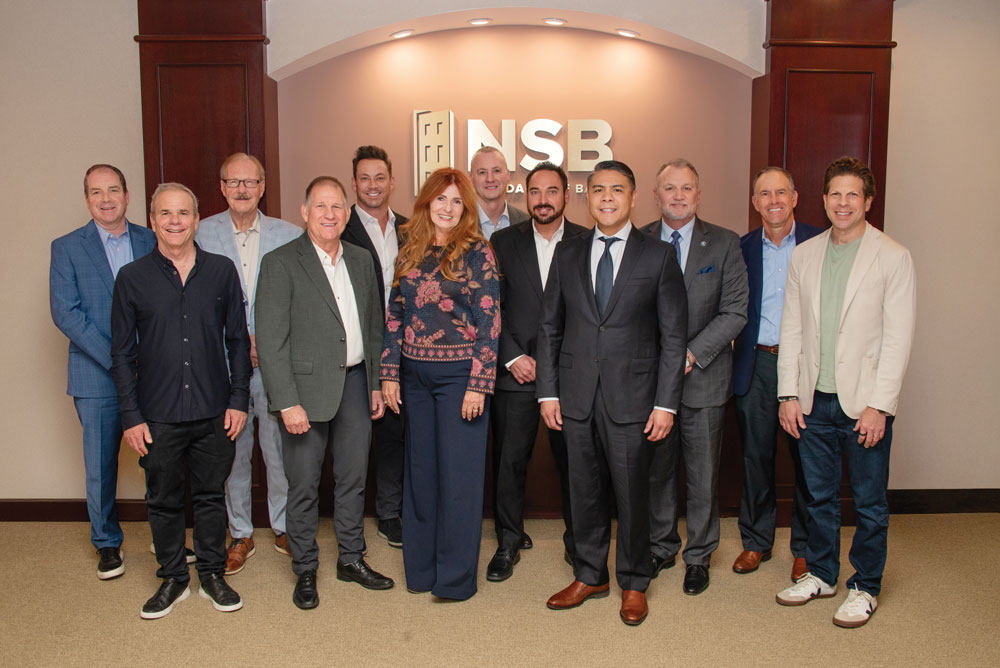
Recently a group of builders and developers met at a roundtable sponsored by Nevada State Bank to discuss the many challenges their industry is facing and the outlook for Nevada. Connie Brennan, publisher and CEO of Nevada Business Magazine, served as moderator for the event. These monthly roundtables bring together different industries to discuss issues and solutions.
What Does the Workforce Pipeline Look Like for Construction?
Kevin Burke: The number one challenge within the industry still is with [finding] both the skilled trades and professional staff.
Robert Potter: We are experiencing challenges with management expertise, whether it be a superintendent or a project manager. We are told they can walk on water, but they can’t. They can hardly add and subtract when they are out in the field. Other than finding the job, the next hardest thing is finding someone to run it properly.
Chet Opheikens: I just read this morning that we have had a 7.2% decrease of people out of the construction industry and out of the trades in Nevada. We are working hard in the community to try and cultivate our young local kids to want to be a part of the trade and to understand that there is a good value in it and that you can make a good solid living with a good wage.
John Ramous: I believe that with AI and everything changing, there is going to be an awakening from that generation. We are going to see a generation that will start to look at the benefits [of the trades].
Reed Gottesman: If you look at the jobs that will be replaced in five to seven years, jobs in craftmanship, that require you to work with your hands, are the jobs that will not be replaced. I think people are going to start to migrate more towards the trades.
Greg Korte: There has been a gradual cultural change over the years. The youth are not wired to take jobs with the intention of working their way up through and organization and stay there long term. Instead, they are willing to jump at a drop of a hat or an increase of 2 or 3% in pay. They also always have to be multitasking. It is ingrained in the way they live and has made it easier for them to quit a job after six months and look for a new one. It is hard to gain expertise and experience within your field or within an organization if you are willing to move that quickly.
Opheikens: At R&O, we require [employees] to have a construction management degree. And we still have a difficult time because [new hires] walk on a job believing, and having been told by a professor, that they are at a certain level when they are not. We try to match them and cultivate that experience with a seasoned superintendent or project manager, but that costs money because now there are two guys on a job and the client did not pay for that. Training is one of the most difficult challenges that we have and finding it here locally is much more difficult than in Utah or in other markets that we look at.
Burke: Deloitte just came out with a national study and as an industry going into 2026, we are short 490,000 in skilled trade. It was similar to that three years ago. We have been on the precipice of about half a million jobs short in the skilled trade. There has been a bit of a slowdown in construction, but not substantially. Thank God the industry has not taken off because we do not have the labor to support it. Instead, it would just drive prices up. The cost of labor will likely not come down for a long time because we are still labor short in our industry.
Jose Bustamante: The labor issue is not just regional at this level, it is a national issue. When you look at markets like California, New York and Texas, they also have shortages of labor.
How Big of an Issue Is Land Availability?
Ramous: Land is the theme every year, but certainly has become much more pronounced with some internal competition here. In the short term, everybody in our industry is trying to stabilize their assets and we are seeing some good progress. But going forward, where is that opportunity for southern Nevada? Where is that next growth opportunity given the constraints that we have now? We used to worry about residential competing with us, but we are now competing with data centers and land pricing expectations, and it has become very difficult for us to develop our bread-and-butter type of assets.
Gottesman: Well located, developable land is a significant challenge because without it, we are constrained. And that constraint does not just affect our business. It affects all the businesses and the health of our community.
Dan Morgan: We have nothing in Washoe County, in Lyon County, and we have checkerboards all over northern Nevada. We can’t grow north, and we can’t grow west because of the California state line. From a commercial, industrial, and residential perspective, northern Nevada is going to start moving towards the east.
Ramous: It (land availability) is an ongoing battle. At one point we got close to making headway and then all of a sudden it was pushed back and we have the same issue. It takes an act of Congress to prove out the fate of Nevada and that is always concerning.
Morgan: In northern Nevada, we had a lands bill going with Senator Rosen until the last Congressional session. It died in committee. Congressman Amodei tried to bring it in the reconciliation process with Senator Lee from Utah, and it was killed by the Montana group in the reconciliation process.
Potter: Part of the issue with the public lands is obviously the federal government, but also that they did not sell a lot at the last auction. One of the reasons for that is because they are having difficulty establishing appraisals within the industry, and so they are establishing the appraisal price higher than it is worth. The other issue is that they are saying there is all of this available land that can be auctioned off, but the problem is, you can’t build on most of it.
Morgan: One thing everybody has to realize outside of the Las Vegas Valley and outside of the Truckee Meadows, is that Nevada has more mountain ranges than any state in the continental United States. It is really easy to look at a map and think everything is flat. Eighty-percent of the land that Senator Rosen had in her lands bill was in excess of 20 degrees slope. You are not going to be able to build many warehouses on 20 degrees slope. When the land is flat, the infrastructure costs are a million dollars a mile. At 20 degree slopes, it is seven million a mile.
Gottesman: The appraisal process is an issue. It is not just BLM, it is also a municipality issue. The process is flawed. When it goes to auction, the pricing is wrong and the land does not trade. There is a price where this makes sense, but because of the locked-in process, nothing happens.
How Difficult Is the Entitlement Process?
Morgan: In Reno, it is a disaster. The biggest issue from an entitlement standpoint that we are challenged with up north is that our local governments have gotten so far outside their lanes in terms of their primary focus, which should be on public safety, public works, parks and recreation, and those kinds of things. We have a significant fiscal crisis in the Truckee Meadows. Every one of the jurisdictions is upside down. They are saying, cumulatively, the number is about $60 to $70 million, but I would guess it is north of hundreds of millions [of dollars] because those local governments have taken on projects and pet projects that they have asked the residential development community to pay for. There was a project north of Reno that at one point, was approved for about 5,500 single family residents. They put $1,000 a door for a fee for affordable housing, and they put $500 on for an aquatic center. They were trying to get their entitlement change to take the whole front half for logistics and industrial. They built these facilities and created this stuff that is outside of the city of Reno’s scope of service. How is it going to get paid for? We are seeing little tiny fee increases in all the jurisdictions. In northern Nevada, on average, we pay between $70,000 and $80,000 before any residential single-family home goes vertical. That is not land cost, and that is not water rights cost, that is connection fees and so forth.
Ramous: There is much more of a vocal population in Reno versus in southern Nevada. It is not uncommon to go through the planning commission approval multiple times. But even prior to that, a project has to go through a neighborhood review multiple times and in some cases that dramatically changes what was originally intended to be developed compared to what is ultimately developed. Las Vegas has started to go through that and Henderson has become a bit more challenging.
Tylere Brennan: The permitting process is a challenge. We are finding across the board that understaffing plan reviewers are diminishing and so it is taking longer. We built the Kylie Ranch Senior Living up in Sparks and it took months to get a review comment back to us. There was one little diagram that we missed, and we had to go to the back of the line.
Ramous: We are seeing projects dragged out for months where once they took maybe three months. Now they take nine to twelve months.
Morgan: Each jurisdiction, now by statute, is required to process things within a maximum of 7 to 10 days. The problem is if they red-lined it, it resets the clock. We have run into issues in Washoe County and Storey County where they will red line a grammatical error, a spelling error or a punctuation error, and use that as the reset.
Opheikens: It has gotten worse. But then again, worse compared to what? Worse compared to 2018 or compared to 2022?
Morgan: One of the things that we are working on in 2026, is to [better] communicate to the local governments. Our group has decided we are going to do the best we can, if necessary include legal counsel in order to hold people’s feet to the fire on that statute. Because if you said “at” instead of “if”, or you miss a comma or a semicolon, they are using that as a reset. They are finding ways to manipulate it. For a while it was much better. But now with the fiscal issues they have and the decrease in volume, we are finding that the staff and planners are finding more mistakes on submittals just to justify their jobs.
Bustamante: [Entitlements] are also a function of land supply. The more land you have, the easier the entitlements. Whereas the less land you have, the harder it is because the city and the county have leverage.
What Is the Outlook for This Industry in Nevada?
Brennan: The largest challenge in ground-up development today is the capital markets. It seems like it is very difficult for private equity to get off the fence. There has been a lot of tightening there, but we have been able to navigate around that with the success of senior living, since senior living offers much higher yields than other asset classes when compared to multifamily, warehouse and office.
Alan Molasky: I am not worried about the long term of Las Vegas. The long term looks great, but the immediate future is not clear. We thought rents were going to go up, and all of a sudden, in June or July of last year, we saw a real decrease. Both our occupancy and our rents dropped.
Gottesman: Every month is not going to be the best month ever. Industrial lease rates dropped easily 40% and now they have retrenched at 5 to 7%. That is not a problem if you look at a five-year or seven-year trend. Things are doing pretty darn well here. We are leasing up. We just completed a sizable development and have half of one building left. I don’t buy everything that I see now. I do think there are certain industries in hospitality niches that are struggling, but I think the world is evolving and things change. There is always going to be somebody struggling while somebody else is doing well. I do not buy the big picture struggle and all the headlines that you read, but it does make for great clicks.
Molasky: Our industry was based upon 4% money for a long time. Rents and expenses were all based upon 4% land and it takes a while for things to transition. Our rents took off during the pandemic and there was a lot of talk about rent control. That is one of the biggest risks I see is that well-intentioned people are taking the solution as rent control, which would not be good for our partners or our renters.
Ramous: Large corporate users have slowed down. We saw over 400,000 square-foot users coming in and now we have seen a slowdown over the last 18 months. The good news is that over the last quarter, we saw a return of some of those.
Korte: The biggest challenge right now from a global standpoint is a lack of clarity for the future and what is going on with interest rates and material pricing and so forth. Material and labor has calmed down and gotten more stable. But particularly here in Las Vegas, there continues to be a wait and see mentality to get clarity on the tea leaves of where things are headed.
Burke: A macro challenge is policy risk. It is the tariffs [that are concerning]. The policy uncertainty makes it difficult to get a read on that as we look forward and invest capital.
Opheikens: My biggest fear is the fear of the unknown. Every time I talk to somebody, it is one of three things: the interest rates, the land availability or the infrastructure costs to get to the land if they are going to buy the land. It seems like most everything has been put on hold. Then you put the tariff on top of it. People are out there getting loans, and they are getting their positioning on their projects put together and there is a fear of getting hit with a 10% tariff on their steel. I have not seen a lot of that come to fruition, but there has been a lot of hesitancy in the market because people are afraid to move forward since they do not know where they are going.
Ramous: We are seeing the Phoenix’s of the world and other areas growing. Secondary and tertiary markets are becoming much more attractive for businesses and attracting diverse workforces, and we are not. We are getting bypassed. Northern Nevada made a conscious decision to let the business community become much more diversified outside of gaming and we have sports here now. That is the diversification that we are seeing, but it is not creating the jobs and the talent that drives some of these national economies that we are seeing thrive. It is the same old issue, but we are not finding the solution at the state level here. I am worried about the 2050 plan. That is my concern. Where does Vegas go after? Where is Vegas? We are not planning that right now, and other communities are.
Bustamante: The biggest challenge right now is the diversification of demand. We have not seen an acceleration of tech coming into the region. What we want to do is focus on our contacts with other tech hubs in the country to be able to lure those types of companies here. That will obviously take the infrastructure needed relative to utilities and business friendly opportunities to lure that.
Ramous: Many businesses have bypassed southern Nevada. That means [less] jobs and tax revenue. In certain sectors there is a slowdown, even though there is a wave of new construction. Over 40 million square feet was developed in the last five years so there is still quite a bit of product built that will house businesses. Many of those buildings are being cut for smaller users.
Morgan: Probably the greatest challenge we have is land availability, costs and infrastructure. The Truckee Meadows and the whole northern Nevada region, from Reno to Elko, south of Tonopah, are all faced with significant demand. As California continues to make a lot of the political decisions they do, it benefits us, but we just do not have the supply. The state as a whole is suffering from that. But it is intensified in northern Nevada.