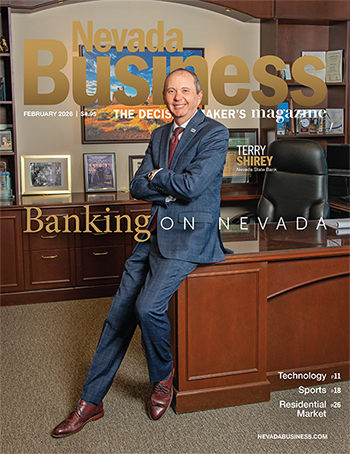
To succeed in 2026, Nevada bankers will have to be expert multi-taskers. They must deal with the burden of government regulations while battling increasingly sophisticated fraud schemes. Predicting interest rates is a constant challenge. In addition, bankers must balance risk and reward with their lending policies and adapt to changes in what customers expect from their local branch.
The Interest Rate Outlook
Interest rates are affected by a number of factors, including the inflation rate, the demand for credit, and the government’s monetary policy. Short-term rates are chiefly driven by the Federal Reserve’s federal-funds rate, which was reduced three times in 2025. Most economists predict only one interest rate reduction in 2026, but what will actually happen remains to be seen.
“We expect a continuing, gradual decline in short-term interest rates,” said Bruce Ford, SVP and Nevada regional manager for City National Bank. “Market conditions can change, but that’s certainly the consensus forecast.”
Politics can also affect interest rates, and when the current Fed chairman’s term expires in May 2026, a new chairman may change the agency’s direction. Jack Prescott, EVP and chief banking officer for Plumas Bank, predicts more than one interest rate drop in 2026. “Two, possibly three, maybe about a quarter point each, is my thought process on that,” he said. “There will certainly be pressure from the administration to do something to further reduce rates. With the change in the Fed chairman, I really do think we’re going to see more than one [rate reduction].”
Terry Shirey, CEO and president of Nevada State Bank, said, “Interest rate expectations are going to change based on economic data and what’s going on in the political world. But, from the perspective of a banker, we look at the yield curve, we look at what the market is telling us, and right now the market’s telling us that rates are probably going to be pretty stable through the end of 2026 – maybe a slight reduction in rates by the end of the year.”
The interest rate outlook is dependent on economic information, which is constantly changing, according to Denette Suddeth, regional president for PNC Bank. “PNC is forecasting one rate change in 2026, but it will really depend on both jobs and inflation data as they come out,” she said. “If you look back at 2025, some folks were expecting a lot more rate changes than what we actually experienced, and some could argue there’s less uncertainty and volatility going into 2026, so you would expect a more stable rate environment.”
The consensus for Nevada bankers seems to be that the U.S. will see a slight reduction in interest rates this year, but it’s difficult to predict the future when rates depend on so many potentially volatile factors.
Considering Deposit-to-Loan Ratios
Over the course of five days in March 2023, three small-to-midsize U.S. banks failed, sending shock waves through the economy. The crisis originated at Silicon Valley Bank, whose clients were primarily technology companies and wealthy individuals holding large balances that exceeded the Federal Deposit Insurance Corporation’s (FDIC) $250,000 limit. Since then, banks, especially community banks, have placed increased focus on the ratio of the loans they carry on their books to the amount of deposits they have on hand.
Ford said the 2023 crisis affected the banking industry’s targets for loan-to-deposit ratios. “We’ve seen a change over the last two to three years,” he said, “If we’re looking for a target ratio now, it’s less than 90 percent, but a couple of years ago, it used to be 100, or even 105 percent.”
Shirey explained the loan-to-deposit ratio is a measurement of liquidity. “I don’t know that there is one ideal loan-to-deposit ratio; it depends on the nature of your deposit portfolio,” he said.
The more stable the deposit portfolio is, which means it has a high percent of FDIC-insured deposits, the higher that loan-to-deposit ratio could be. The more you can count on those deposits remaining stable through different economic cycles, the higher those loans can get as a percent of those deposits. Then, the bank can feel comfortable that it can withstand crises or other economic events. Personally, I like the number 80 percent. It implies that you have excess liquidity on your balance sheet, but it also produces a high level of profit.”
Prescott said the 2023 bank failures were “a real wake-up call for everybody to maintain good liquidity and not push that loan-to-deposit ratio too much.” He said, “We like to stay around 80 percent, maybe push it to 85 percent loan-to-deposit ratio. That cushion is nice to have in case of unexpected events. And, obviously, you want to get the most FDIC-guaranteed money.”
Suddeth said “PNC’s loan-to-deposit ratio is in a healthy range around 75 percent, which indicates that we have strong funding from a stable customer deposit base. We really focus on that funding source instead of relying on more volatile funding sources.”
Battling Cyberfraud
As long as there have been banks, those banks have been battling fraud. Scammers have counterfeited money, washed paper checks to make them payable to themselves, conned seniors out of their hard-earned bank accounts, and more. The advent of the digital age has given criminals even more opportunities for fraud, and bankers are developing their own cyber tools to keep up.
“We have a whole army of people who wake up every day thinking about cybersecurity and protecting our clients, as well as the bank,” said Shirey. “It’s an ongoing battle to stay ahead of the fraudsters, who are continuing to innovate, so we choose to invest heavily into defenses against that. For business clients, I always like to recommend using the Positive Pay services that your bank provides, because check fraud is one of the bigger areas of risk for businesses.”
Plumas Bank is making significant investments in cybersecurity, according to Prescott. “It’s important to keep up with what’s going on in the industry from a peer standpoint and to share that information with each other,” he said. “And, we provide ongoing education, not only for internal team members, but for customers as well. We have joined up with cybersecurity professionals to sponsor seminars for business owners in the community. More than anything, it’s important to stay aware and educated and have ongoing training for both team members and customers.”
Suddeth said PNC recognizes that cybersecurity has become increasingly important. “We combine our cyberfraud team with physical and insider threat monitoring so that we can enable real-time awareness and strong protection for both our customers and employees,” she said. “Beyond technology, we invest in educating our clients through campaigns on emerging risks – things like malicious QR codes, deepfake impersonations and other new cyberthreats.”
The Graham-Leach-Bliley Act contains requirements that banks safeguard sensitive data, noted Phyllis Gurgevich, president and CEO of the Nevada Bankers Association. “Banks have earned the reputation of being the gold standard in data and cybersecurity, but there’s no resting on our laurels,” she warned. “The fight against fraud is on multiple fronts. It’s protecting and locking down that data, but it’s also preventing other types of fraud. Preventing fraud and scams has to be the biggest challenge that banks are facing right now. Customer education helps, but it’s not enough. Specifically, I think we need to see state and federal requirements that telecoms and social media companies block fake caller ID, block fake bank text messages, and take down social media accounts that are pretending to be somebody else. It’s an area where banks are truly committed and investing a lot, but we can’t make it safe by ourselves. We need customers and all the stakeholders at the table.”
Right-Sizing Banking Regulations
Compared to other business sectors, banking is highly regulated, and its operations are restricted by a myriad of federal and state rules. “When the current administration was coming in, they stated they were going to lower regulations,” said Ford. “I’m not sure that will happen, but I certainly don’t expect more regulation [in the near future.]”
Prescott agreed, saying, “The forecast for 2026 is that it will be a mild year for new regulations and it will bring lighter regulatory burdens overall. The new rules are centered around digital assets and payments, and stablecoin rules come into effect this year, as well.”
Shirey predicts “a continued lighter touch from regulators.” He said, “Under this administration, there are some changes coming around leverage lending, for example, where the regulators were very prescriptive in the past around how much leverage lending a bank could do. They are looking to ease up on the requirements around that. They will certainly still be monitoring bank portfolios and expecting banks to engage in good underwriting on leverage loans. But that’s just an example of where they are taking more of a free market approach to our industry and being less prescriptive.”
Gurgevich provided details of some legislation affecting banks. “There won’t be a lot of new regulations, but we expect a bit of a reset,” she said. “Some regulations may be outdated or misguided. It’s always important that the regulation be, as we like to say, ‘right sized and meaningful.’ One of the best examples of that is the Community Reinvestment Act. A new rule had been issued, and the way it was written would have seen Nevada receiving a smaller share of community reinvestment from banks that operate in the state, but are headquartered somewhere else.
Our state would most likely have seen a reduction in the required amount of community reinvestment from those banks, and so it’s good to see that regulation was pulled back.”
Gurgevich added that Congress recently enacted the GENIUS Act, the legislation that enables stablecoin, which can impact the banking industry. “There will be additional legislative work,” she said. “Congress is now looking at the market structure for stablecoin, and regulators need to lay out the rules of the road. Stablecoin is intended to be transactional, as opposed to a storage of value. The difference between the two would have a huge impact on deposits in the community. Bankers want to make sure that stablecoin is not eligible for any yield or interest, so that we don’t see a displacement of deposits. Bankers want to protect deposits in the community, because that’s what fuels lending and enables a community’s economic growth.”
She added, “Another regulation that really affects consumers is Dodd-Frank 1033. As originally written, when banks were sharing customer account information with third parties, we didn’t believe the consumer who was giving permission [for sharing their information] had the proper disclosures. We’re working on getting that one right-sized so consumers know who’s going to have that information, where it will be stored, and how it will be used.”
Gurgevich also described issues with section 1071 of the Dodd-Frank bill. She explained, “The legislation as originally written required a minimal set of data to be collected from small businesses before they could get a loan. The new rule bumped up the number of questions by about eight times, and they were deeply personal and invasive. We want to bring that rule back to the original congressional intention, making that data collection something meaningful and not invasive. [Those new regulations] might send a small business owner somewhere else for their loan instead of a bank – somewhere that’s not subject to regulation – to get their funds, and ultimately those alternatives are usually not safe or affordable.”
Congress has already legislated on these issues, and now it’s time for the regulators, particularly on Dodd-Frank, to act on that legislation and promulgate the proper regulations, Gurgevich explained. “This reset and right-sizing is something [the Nevada Bankers Association] is actively engaged in with the regulators.”
Bank Branches Face Change
Because so many customers now choose to conduct their banking business online, the role of the banks’ branch network is changing.
“Branch traffic is definitely down from where it was historically, and it continues to decline every year,” said Shirey. “We saw that accelerate during the pandemic, with a lot more customers adopting online banking and learning to self-serve. The way we’re adapting is to continue to make it easier to self-serve through mobile or online banking, but also ensuring that our branch colleagues are adding value to clients when they do come into the branch. We have fewer colleagues in our branches than we did historically, but those who are there are more expert in providing solutions to our clients. We are increasing their skills in business lending, for example, and identifying wealth management opportunities for clients who may never have had a conversation about what to do with some of their assets.”
Prescott said Plumas Bank is also focusing more on adding value to the in-branch experience. “Instead of having tellers, we have customer service specialists who are trained in all products,” he said. “Not just handling cash transactions, but handling new accounts and all of our loan products as well. They have become more consultative and professional in helping clients. We’re in the people business. Human interaction is still very important to a lot of people. It’s important to have that strong relationship and that human connection, somebody to talk to and work with.”
Suddeth said PNC Bank is continuing to develop technology that enables clients to open accounts faster and more easily online, while also maintaining its branch network. “Part of PNC’s delivery model, in addition to the retail branch network, is a very robust online platform and a customer care center,” she said. “What we’ve seen historically is that an overwhelming majority of accounts that are opened online are within a few miles of our retail branches. Consumers have changed a lot of their banking habits, but they still rely on the face-to-face interaction in a retail branch for many transactions.”
Ford said City National is not planning to reduce its branch network in response to market changes. “One of the things we think distinguishes us versus our competitors is we believe there’s still a niche for clients who want to come in and talk to a banker and interact with a person,” he said. “We have no plans to downsize. In fact, we’re pretty positive on Nevada, and if anything, we’ll expand.”
The 2026 Outlook
Overall, Nevada bankers are taking a “wait-and-see” attitude toward interest rates through the rest of the year, with some gradual reductions expected. Keeping the 2023 bank failures in mind, they are being conservative in their loan-to-deposit ratio, to be better prepared for any unanticipated economic events. Working with the Nevada Bankers Association, they hope the burden of restrictive regulations can be eased. They are adapting their branch network to changing customer demand, and, as always, they are developing new tools to fight fraud on many fronts.
Plumas Bank Celebrates 45 Years

The end of 2025 marked a meaningful double milestone for Plumas Bank: December 15 was the official 10-year anniversary of the community bank opening its first Nevada branch in Reno, as well as the 45-year anniversary of the bank’s founding in nearby Quincy, Calif. Today, Plumas Bank is one of the top-performing community banks in the country with a total asset size of $2.2 billion. The bank offers 19 branches including locations in Reno, Carson City, and Lake Tahoe, and more than a dozen branches serving Northern California communities. Additionally, it is a preferred lender with the U.S. Small Business Administration serving seven Western states.
In recognition of the milestone, the City of Reno officially proclaimed Dec. 15, 2025 as Plumas Bank Day, honoring the role community banking plays in supporting local businesses, families, and regional economies. The proclamation — issued by Mayor Hillary Schieve — reflected both Reno’s prime location as a central economic hub for surrounding rural communities, and its importance to Plumas Bank’s growth and evolution. While the bank’s roots were first planted in Northern California, Reno is a critical connector between many of the communities the bank serves throughout the region.
“Reaching 45 years as a community bank while also marking a decade in Nevada speaks to how intentionally this organization has grown,” said Plumas Bank President and CEO, Andrew J. Ryback. “Our steady growth across interconnected communities reflects the role community banks play in strengthening local economies and building relationships that last across generations.”
Plumas Bank’s Northern Nevada presence grew through a series of deliberate, regionally connected steps. Just after its 20th anniversary, the bank opened an office in Truckee in early 2001, recognizing the close economic ties across the California–Nevada state line. The early 2000s saw continued expansion throughout Lake Tahoe and the Sierra, strengthening service in mountain and rural communities. And then in 2006, Plumas Bank established a commercial real estate loan office in Reno.
 See the bank’s full timeline in its recent Corporate Citizenship Report.
Nevada Becomes Corporate HQ
After the Reno branch opened in 2015 and a Carson City branch opened in 2018, Plumas Bancorp [Nasdaq: PLBC] relocated its corporate headquarters to Reno in 2021. While Plumas Bank’s administrative headquarters remains in Quincy, this move underscored Reno-Sparks and the greater Truckee Meadow’s role as a rapidly growing hub for commerce, innovation, and regional collaboration.
“Community banking works because it’s rooted in understanding local markets and investing in the people behind the businesses,” said Vice President, Business Advisor and Reno Branch Manager, Kyle Whaley. “When decisions are made close to home, community banks can respond thoughtfully, support job creation, and grow alongside the communities they serve.”

The bank has worked with local entrepreneurs and commercial clients navigating growth, transition, and economic cycles. Over the past decade, the Reno, Carson City and Lake Tahoe branches have supported a wide range of industries, from professional services and healthcare to manufacturing and real estate, while remaining connected to the bank’s broader community banking mission.
Serving the Evolving Economic Landscape
 Plumas Bank’s 45th anniversary arrived during a period of continued economic evolution for Northern Nevada, as businesses balance workforce growth, technology adoption, and regional expansion. Community banks remain a key part of that ecosystem, offering local insight supported by robust banking tools.
“Over 45 years, a lot has changed — how businesses operate, how technology supports growth, and how communities weather economic cycles,” said Whaley. “What’s stayed consistent is our ability to adapt alongside our clients, invest locally, and remain a steady presence through periods of rapid evolution.”