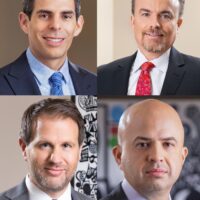
The arts and culture industry in Nevada is a growing one. And while the Silver State boasts many individual talented artists, the art community is establishing itself in ways never seen before in the state. However, art in Nevada is not without its challenges. When compared to more established states, the arts industry is fairly young in Nevada. The industry also is challenged in differentiating itself from the entertainment sector the state is known for. Recently, arts and culture stakeholders met at a roundtable sponsored by City National Bank and held in Las Vegas to discuss the many challenges the industry faces including fundraising, educating the next generation and the outlook of art and culture in Nevada.
Shannon Scholten-Adams, vice president of Nevada Business Magazine, served as moderator for the event. These monthly roundtables bring together different industries to discuss issues and solutions.
What difficulties do you face in regard to fundraising?

Tony Manfredi: One of the shorter-term challenges is simply rising costs. The inflation we have seen from a lot of our artists and arts organizations is of great concern. A few are seeing some recovery from the pandemic, [but] others are still not at full capacity around the state due to the pandemic.
Melissa Kaiser: We have a lack of fundraising professionals and a lack of individual philanthropists that call this community (Las Vegas) their home. [There is] so much competition for fundraising for the social services and not enough donors to go around.
Manfredi: The U.S. Bureau of Economic Analysis cites about $9.4 billion of economic activity in the arts, 4.8 percent of our economy [is in the arts including] around 40,000 jobs. About $3 billion of that is actual arts and economic development and the rest is in the support services. There is a tremendous economic impact that the arts and creative industry have in our state.
Kaiser: We have very strong corporate support in this community, and I think it is going to sustain us as we keep growing. But what I see missing are the individual philanthropists. An individual philanthropist historically gives to the community they grew up in. [They donate to] the hospitals, the universities, the art and cultural museums and social services that are in their community. As a more transient town, we must have a community.
Jonathan Ullman: We need a culture of giving and support and particularly people that have affluence to see the value in these various institutions to the community and the importance of sharing within the community and helping to make these places more accessible.
Kaiser: There is a timeline of simultaneous parallel development that we need to do, not only with our casino partners, but with the individuals that call Las Vegas home [in order to encourage more philanthropic giving].
Dr. Nancy Uscher: The casinos have their own life. They are immensely important to the lifeblood of [Las Vegas]. But on the CEO level, some of those hotels or those enterprises are [not only focused on] hospitality. They understand that everyone benefits from celebrating the variety of opportunities here [including art]. That is an area that could be further explored. A lot of their money is coming from casinos, but I do think that the people in charge of those corporations are enlightened. They are looking more broadly at how to be community members.
Kaiser: But we also cannot just look to the casinos to foot the bill for the things we want to do in the community.
Ullman: [We have] the responsibility to help people understand why we matter and why we are different. If you think about our patrons in a generic consumer sense, there are so many options in this town for entertainment, music and other types of exhibitions that other parts of the country do not have. From a consumer perspective, there is not necessarily a differentiation between a nonprofit cultural experience that [they] want to support for the good of the community, as opposed to similar but different types of entertainment that is enriching. That is kind of murky. It is not necessarily intuitive as to why [they] should go to the nonprofit cultural institution. [The challenge] is, how do we make it more clear in the way in which we communicate and in what we do, that what we are doing matters from the perspective of community building, so that it is worthy of that support?
Shelley Allen: From Pahrump’s point of view, we do not feel like we have a lot of support in the community simply because it is mostly a retirement community and the kids have not been raised around the arts at all. [Compared to other] subjects in schools, art is [considered] an easy class.
How are you working to promote art education?

Manfredi: We need to work on building a sense that the arts are not just an elective to be had at school; they really do need to be integrated and required in our education system. That is something that I am focused on and the agency is focused on long term with our school boards and our state education system.
Allen: Kids have lost interest [in art] and there is no way to have that support when they go away for school. They are not going to stay in Pahrump, and eventually when they come back with their own families, they do not have that love and understanding or appreciation for the arts.
Jenn Kratochwill: One of the challenges is creating a sustainable model for supporting arts education because, for us, that is where it begins. That also leads to strengthening our corporate philanthropy infrastructure so that is what we are focused on. We are calling it “The Next 50 Years”. We are moving from a founder driven organization to an institution and we are looking at what that means for our legacy for the next several decades and beyond.
Kaiser: We are trying to teach the innovators of the future with STEAM (science, technology, engineering, arts and mathematics) education. We are supplementing what is happening in the classrooms. [Art education is] workforce development. We are thinking ahead. We are also in a campaign for what the next ten years [will] look like in homes and the skills that kids are going to need, [including] the ways that jobs are changing and the way that technology factors into the arts.
Ullman: We invested in going out to the schools and reached over 10,000 students last year. Going out and meeting them where they are is impactful. But it is not the same thing as a young person coming into a museum and experiencing what it is like to be in a museum and feeling and believing that these places are for them. That is a big part of getting the community to really value and embrace arts and culture. [It is important to] make arts and culture accessible and something that people feel is for them.
Manfredi: We are making sure that we drive STEAM education and incorporating that creativity. That is what really drives innovation, teamwork and collaboration. [It is important that] we start changing the narrative around what arts, creativity, culture and heritage really means and does for our communities.
Uscher: [Art education is] really creativity education. We have to shake up what we think of as arts education as being sort of stuck. It is not. It is dynamic.
Kratochwill: It is not about making these students professional ballet dancers. It is about pulsating the next generation of arts patrons and those that are going to appreciate not just our art form, but the arts in general.
Kaiser: We are shaping what we hope [will be] kids that are going to stay in this community, join the workforce, use those skills, and become our future donors, our future patrons and leaders, and our organization’s leaders.
Uscher: It is important to us, at the college [level], to not only produce people who make art that goes into the galleries, but also have our students look at themselves as transformative. [We want them to view themselves as] people who can help transform society, [be] change makers and help people thrive and get to know about society and life through their particular artistic talents. We can celebrate this opportunity for the arts to matter in different ways and that has to do with teaching our students to be change makers.
Alice Sauro: We are not [focused on making] professional musicians or professional dancers. [We are focused on] helping people be the very best that they can be and share and grow, which then makes this community better.
Uscher: We have been working over [recent] years to try to help students make meaning of where they can be in their world. We have some wonderful internships at the philharmonic this year and were granted some funding to bring interns into three women’s prisons [in Nevada]. We are talking about teaching artists and community art fellows. We are bringing students into other venues [such as] homeless youth shelters. We all work in the social realm in what we do in the arts, but we have to think beyond a former definition of art education.
Kaiser: At the DISCOVERY Museum exhibits we have a performing arts area and [we are trying to teach] kids that [art] is not [only] the artists you see on stage. Someone has to pull the curtain, someone has to do the lighting and [control] the sound. These are all careers if you love the theater [that you can have] here in Las Vegas. We are trying to teach [children] that there is more to [art] than meets the eye.
Steve Rice: We bring kids into the orchestra and see their eyes light up and [hear] the questions they ask when we have young performers perform in front of them and that is what we are all about. If we could grow our budget, that is the area that I would want to focus on. I want to do more in schools because that is where the support comes from. [It is important to] get young people engaged.
What is the outlook of Arts and culture in Nevada?

Ullman: [Las Vegas] is a relatively young community in terms of arts and culture. The degree to which people feel engaged and people invest and support arts and culture [is also very green here]. There is a lot of opportunity, and it certainly is growing.
Kaiser: [In other cities], there is a perception that [Las Vegas does not have] an arts community and I think it is because we are a relatively new city, which is also an opportunity. People said we were not a sports city either and we proved them wrong. We are a growing city, but philanthropy has to support the arts and culture.
Demecina Beehn: I think one of the biggest challenges for Las Vegas is that we are not taken seriously in the art world. There is a need for us to take a bit more risk to be a part of the contemporary conversation.
Jerry Schefcik: Las Vegas is an odd duck as far as the demographics of the city. And things have changed dramatically [over the years] and they continue [to change]. [Las Vegas] is growing and expanding and the recognition [of arts and culture] is coming, and that is what we are working for.
Uscher: We need to try to move toward a shared understanding that the arts are a fundamental and integrated part of health and well-being and the healthcare system in society.
Manfredi: I am continually trying to drive in all of my conversations to the importance of arts integration and getting the general public and our elected officials to understand that the arts are in everything and around everything and can help support everything.
Beehn: I have a positive outlook for art in Las Vegas and I hope to see a lot more diverse representations, diverse conversations and diverse visitors within our culture.
Manfredi: There is a better awareness about the value that arts and creativity and culture and heritage provide to all of us. One of the many things the pandemic showed us was the world without the arts per se. [When we] shut down [there was an inability] to have these experiential activities together. [Now] there is a better understanding around what the arts and creativity really bring to us. We have a lot of work still to do, but it is going in the right direction.
Uscher: I am very optimistic [about the outlook for arts and culture in Nevada]. We have fantastic art leaders and we are very imaginative. We are going to come up with some great ideas and solutions because we are very creative and that is what we want to teach our children as well.