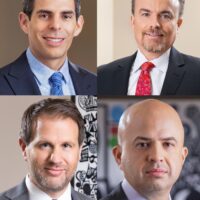
Photo by Bryan Hainer
The legal landscape in Nevada has undergone significant changes in the past few years. From remote court appearances due to COVID, to issues of poaching employees, compliance and a downward trend of new talent entering the field, adjusting attorney practices has become the norm. To connect and discuss the issues they are facing collectively as an industry, a group of attorneys recently met at a roundtable sponsored by City National Bank and held in Las Vegas.
Connie Brennan, publisher and CEO of Nevada Business Magazine, served as moderator for the event. These monthly roundtables brings together different industries to discuss issues and solutions.
WHAT EFFECTS DID THE RECENT PANDEMIC HAVE ON THIS INDUSTRY?
Samuel Schwartz: The largest issue facing the [legal] community at the moment is communication from the COVID breakdown. How do you communicate with people [now]? What can you say to people and when you can talk to them? Is it online? Is it a Zoom conference? Is it in the office? Is it on the phone? Is it on your cell phone? Is it at home? At Starbucks? Where can you talk to people? When and where are the lines of how to communicate?
Richard Dreitzer: One of the upsides of COVID has been Zoom court. As a litigator, there is a whole segment of hearings and matters that you [now] do not have to run down to the regional justice center to deal with. That saves you time and that saves the clients money on fees because you are not waiting for the whole calendar to be handled. I am hopeful that the courts will learn the lessons of remote Zoom court and incorporate that into their cases as they go forward.
Keith Pickard: Here [in Clark County], except for trials, we are exclusively remote [with courtroom appearances]. It is rare to have somebody show up. The rest of us prefer to be in the office. It allows me to mute the mic and have a conversation with my client that I know will not be overheard. You can’t do that necessarily in courtroom.
Schwartz: I think there will be an online presence that sticks around in many courts [due to the pandemic] because it eases access for the client. The client can call, they can get on Zoom, they can listen and they can hear the arguments. [They can] hear the judge’s ruling rather than hear from us. That is one of the biggest improvements from COVID as it allows access for clients that really was not there before.

IS STAFFING AN ISSUE FOR ATTORNEYS?
Leah Chan Grinvald: The interest in higher education, and more specifically in legal education and getting a JD, is on the wane. And I think that it has been a perennial challenge; it is cyclical. It is absolutely a challenge that we are going to face given demographics and everything happening around the country.
Tim Lukas: Some of our biggest challenges have been trying to find attorneys and staffing them up. There has been a lot of competition that has seen us lose younger talent to firms that are willing to pay 50% more than they are [currently] making. Frankly, it has been very hard for us to compete with that in our client area and in our client bases.
Grinvald: I am not sure what the reason is [for less people pursuing a JD]. I am not sure if it is the cost or the time [of the education] or maybe the stigma of being an attorney. But the folks who are taking the LSAT (Law School Admission Test) have continually declined and that is the biggest indicator of who is going to be applying to law school.
Dreitzer: [The result of less people pursuing a career in law] becomes an access to justice issue. You have people of limited means that need attorneys to represent them, [but if] there are fewer attorneys going through the system, the less access they are going to have. That puts wealthier people at a great advantage over less wealthy people. And that is an inequality in society we have to fix.
Shwartz: If you read some of the news about where the bigger firms are, they are beginning now to slow [their] hiring [which will aid in poaching issues]. The great equalizer appears to be here, which is some sort of a recession in the future.

HOW DO ATTORNEYS MAINTAIN TALENT?
Dreitzer: The differentiator is the culture. [It is] projecting a good firm culture where people are going to feel appreciated. Every business says they are people friendly, but you have to do certain things to carry that out and to really prove it. For me it is a simple thing. I try to be the mentor, the supervisor, and the boss that I always wanted to have. I try to really connect with the folks that I work with, so they know I am not just in a position of authority, [but] that I am actually there for them for whatever they need. If you treat people the right way, that carries forward.
Schwartz: Once a quarter, I try to take everybody to dinner. Everybody [gets an] Uber so they can have a few drinks and can say a few things they might want to say [but would not normally]. We have those kinds of conversations and I think that is how you keep people around because you [do not] just let them head off and do their remote work. There is a clock on that person. That person has some level of value and at some point, they will move on. They will get the training they need [and] they will go to the next job.
Pickard: When I opened this second iteration of the firm, [creating a family atmosphere] was the first thing on the agenda when we were interviewing people. We wanted to make a place where they felt like they were with family and wanted to come to work. They are going to spend more time with us than they will with their family so we want to be their family. And we were overt about it, and now the only people that have ever left are people we let go.
Schwartz: It starts with mentoring [but also] you have to be in the upper end of the market as far as what you pay people to keep them in place. And what I have found is giving people room to make decisions, get involved and make mistakes, has been a big part of how key people run. [When I focus on] paying them right and giving them a voice, I am finding that helps keep people around.
Grinvald: The generation that is coming up and the newer attorneys, if they are not looking for money, then they are looking for the “Why.” [They ask themselves], “Why am I doing this? How am I being engaged? What meaning does this have for me?” [Answering those questions] is how you recruit and absolutely is how you retain. [It is about] engagement and making them feel a part of something bigger than just going after the big bucks.

HAS TECHNOLOGY CHANGED THIS INDUSTRY?
Michael N. Feder: [Drawing boundaries with clients is where] the COVID world and technology has collided. I tell people all the time that I do not believe clients know the difference between home and office anymore because people started working from home so much. [Clients] are so used to not calling you at the office anymore, so they call you on [your cellphone] since we are not always in the office as much. That is the part I think has collided, that element of home. They don’t understand your home.
Lukas: You are always connected, and you have to draw boundaries. We respond [to clients] when they have an emergency [after hours]. But if its 8:00 p.m. at night and I am having dinner with my wife, I am not going to answer your text. I will get to it the next day.
Feder: With attorneys watching other hearings virtually, they are not paying attention to those other hearings. Whereas when you are in court and you are on a stacked motion calendar and you are all there, you are observing, and you can see the different styles of how different people do it. All those elements come into play [and affect the training and mentoring of newer attorneys].
Brian Vasek: I think that if we are going to continue to do some sort of online telephonic appearances moving forward, some sort of universal standard for how we ultimately address council and priority cases could be helpful.
Dreitzer: Technology does have an upside to it in terms of case management. We have these large cases with hundreds of thousands of pages and I remember the old era when everything was on paper. Now you just manipulate some PDFs and you have got everything in front of you. That has been a godsend for me.
Lukas: [There is an issue of cybersecurity] that is really tragic when you get to a closing. We do a lot of big financial closings and right before the close you get this ping email and it looks like it is from the client. In fact, it may be from the client’s server who got hacked and says to redirect the escrow and proceeds someplace else. We have not gotten hit, but some of our regional partner firms got hit for millions of dollars by sending it to the wrong account.

WHAT IMPACT IS THE TREND TO WORK REMOTELY HAVING ON THIS INDUSTRY?
Dreitzer: The challenge that we are facing is [asking ourselves] what kind of law office do you need, or must you have in a post COVID environment? We just moved to a [new] space and condensed our footprint significantly. And then the question is, with remote court hearings and remote work and people working in areas that do not lend themselves to court appearances, how much of a real estate presence do you need?
Ashley Horan: I got rid of our office completely. I work out of the house. If I have a judge or court that needs something, they are not coming to me anyway, so I am going to them.
Feder: Within our firm there are some people who decided they were more efficient working from home. They do not need to be in the office every day and that has impacted even the staff they work with. I believe that is going to continue, I would say at least a few more years, but I think it is going to be longer.
Horan: COVID [has] allowed us to have that work life balance [with remote work]. And as a single mother and as an executive, it is a balance and it is imperative to have that flexibility.
Lukas: The last couple of years, what we have seen across our footprint, is mid to younger level associates getting picked off by large national firms who will give 30% or 50% more base salary and will allow them to work 100% remote. That has exacerbated the talent drain in certain segments and in certain practice areas, because it is hard to attract a 5th year corporate attorney to move to San Francisco from Reno, Boise, [or] Salt Lake City. You might go to LA for a 30% salary bump [but] you are going to have to pay state income tax and you are going to have to have a long commute. There used to be a barrier of why they did not go, [but with remote work being the norm] that barrier does not exist anymore, and I do not see it coming back anytime soon.
Feder: With remote work and people having an issue coming back to the office, even as things are opening up, I feel bad for our younger attorneys not getting the true mentoring they need. I think the mentoring part is something we all need to go back to and focus upon now that we are somewhat coming back together.
Dreitzer: As an employer, you want to be as flexible as you can be because if an associate wants to work from home for some portion of the time and you say no, they will go right down the street to the next person that will let them do it. But then they are missing out on the training and the mentoring and the informal things which make them better attorneys. So where do you kind of drop the needle on that problem? That is what I struggle with all the time.
Feder: You have to make the time to get together with [newer attorneys]. I hate the fact that when I am working with someone on a case, [I have to ask], “do you have time at 11:00 a.m. to have a call to talk about this?” as opposed to just going in their office and talking about the case right now. We are getting back to that part with some of these attorneys being back in the office. But how do you go back and [address the fact that attorneys] in the last couple of years did not have that training and mentoring?
Schwartz: I think you are going to see firms begin to differentiate themselves between in the office and remote [work]. We will see a bit of a breakdown and people will begin liking particular firms that allow remote work versus the firms that want them to be in the office. Those who want to be in the office will be [at firms that do not work remotely].

WHAT REFORMS WOULD THIS INDUSTRY LIKE TO SEE WITH THE JUDICIAL SYSTEM?
Pickard: In Clark County, from a judicial standpoint, the struggle we have had is with new judges. In family court, half the judges are new and several have never practiced family [law] a day in their life. We have to educate the judge and the hearings are taking longer than normal. [If] you get an experienced judge, they can get in and get it resolved pretty quickly. With the new judges, some of them just do not like making tough choices.
Schwartz: It is important for lawyers to be able to give good advice to clients of what to expect from a judge. And when you have unpredictable jurists, it becomes difficult to give clients good advice. [I like to tell my clients], “This particular judge has this particular quirk, and so I suggest we don’t do that because I can tell you from past cases or prior experience that this is not going to go well.” That is what clients need. [They need] certainty in terms of what you are telling them and having an uneven panel of judges makes that difficult.
Dreitzer: The problem [with our current judicial system] is human nature. If you have two litigates in front of you and one has made a donation to your campaign and one has not, you may have a tendency to favor the person who has contributed, even if you are not aware that you are doing it. I am not saying that there are people that decide things that way, but it is a fraught system to have donations creep into how you make decisions.
Lukas: Our total free-for-all election system that we have right now is broken. We spend more money on things like pretty pictures [and waste a significant amount of funds]. We have qualification standards in the Nevada Constitution of what it takes to be a district court judge and justice of the peace and if you appoint, you are going to have the same political fingers that elections are supposed to keep out of it. If we can take lessons from other states that have done it, the initial appointment and retention vote would be much more efficient for the system. It would take out the appearance of impropriety because when people run for office, particularly if they are a city judge, they are not looking for anything that is untold in terms of asking for campaign contributions. But it is expensive to run a campaign and they need to get their name out there. I think it is time for us to take a hard look at [the current election system] again.
Pickard: We have people who really have no business being on the bench in family court, and it is showing up in their work. Nevadans want to vote for their judges. My thought is to approach it from the other side and maybe improve the qualification requirements or at least require that they work in the practice area that they are sitting in.
Schwartz: Why I struggle with Nevada’s [system] and why I think the elections are troubling, is because you end up with judges that are not necessarily well qualified for that particular position and now you cannot give any kind of certainty to the client [about] what they are going to see in court.
Dreitzer: Having lived here a while, I have learned that Nevadans like to vote for their judges. That is just the way it goes. I do think there has got to be a hybrid way so people can vote for judges, but [also] incorporate the wisdom of how that person is as a practitioner [and] that comes from the legal community.
Feder: I think the best hybrid is to appoint the right judge and then go through the retention. If they do not get their retention, then put up for a general election. From that perspective, Nevadans still get the opportunity to have a say,
WHAT IS THE ATTITUDE IN THE LEGAL COMMUNITY REGARDING PRO BONO WORK?
Schwartz: What makes the legal profession wonderful and terrible is that you can make a lot of money doing it if you do it for a long time. It takes a little while to get to that level, but you have to give back. It comes with it.
Feder: I am a true believer in pro bono partners and pro bono programs. It gives young attorneys opportunities they may not otherwise have [and] you are helping the community. I think it is so important and has to be part of the culture of the legal community to do that.
Grinvald: We are attracting students who want to give back and who are attracted to Boyd law [school] because of our emphasis on community service. Whether that be a public interest job like district attorney, a public defender or pro bono work. We have some of the highest numbers of pro bono percentages among Boyd grads, so we are really proud of that.
Dreitzer: The more people you have going through the system, the more [attorneys] there will be to do pro bono [work], take public service jobs, public defender, [offer] legal aid, et cetera. If the numbers are drying up, it is going to hurt the lower end of the spectrum much more so than the wealthier end of the spectrum.
Vasek: It is something that is so crucial to my practice and my attitude towards clients. We sometimes have cases that come in and the client can’t afford what my retainer normally would be and I am okay with that because there is a unique issue with the case. That may be a case I take either for free or I can do a much more modified retainer. [It allows me to] help out a client, make a friend for life, and make a friend of the firm for life. It is just such an integral aspect to our day-to-day operations. Those are not the cases that make the money, but it is integral to how we are structured and why I started my own practice five years ago.
Schwartz: If you stay in your lane [effective pro bono work] is actually quite easy to do. [Find] what you are good at and to do that for people who you can help. Make a friend for life and make a friend of the firm. That is the way to be efficient and effective and it is what you should do if you are going [to give back] to the community.
Dreitzer: If you are in the legal profession, there are a lot of benefits that go with that. And what comes with that is the obligation to give something back.