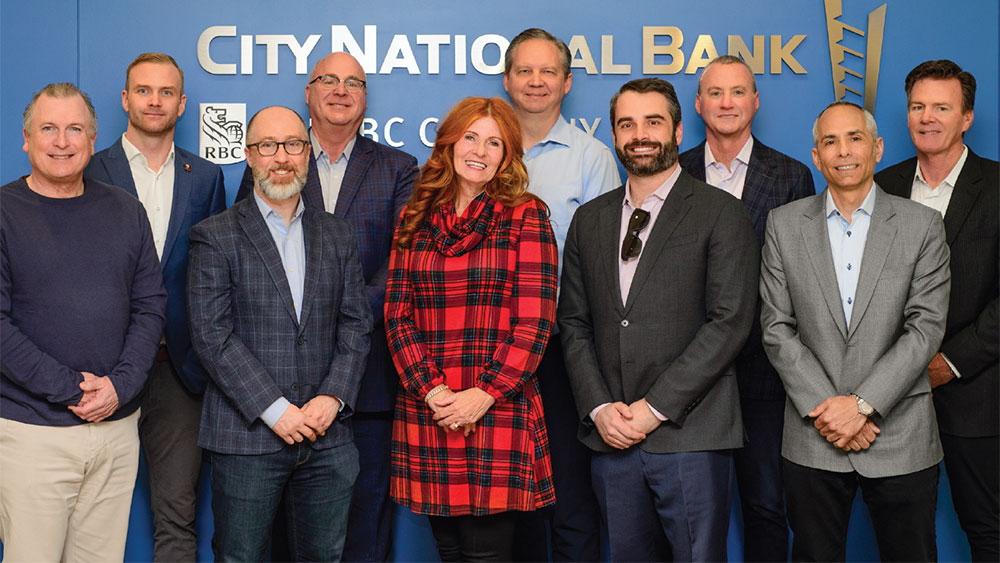
Commercial real estate in Nevada has seen its share of challenges and continues to face an uncertain market. Facing common issues of labor shortages and supply chain constraints, builders and developers are navigating a shifting market, concerns over capital and struggling to meet deadlines due to red tape. Commercial real estate executives recently met at a roundtable sponsored by City National Bank and held in Las Vegas to discuss the challenges they face as an industry.
Connie Brennan, publisher and CEO of Nevada Business Magazine, served as moderator for the event. These monthly roundtables bring together different industries to discuss issues and solutions.
How is the health of commercial real estate in Nevada?

Frank Marretti: It just depends on the submarket. If you look at certain submarkets, specifically in the Southwest, [such as] the medical districts and certain private and public environments, I think it is super healthy. There is pent up demand. But if you look at some other areas, it does not look so good. It is spotty. There is a lot of optimism and there are some areas of huge concern.
Larry Monkarsh: During the pandemic some malls were definitely struggling. I am not so sure they are going to come back the way they were, but I do not think the option to turn those into industrial is there. We have tried that a couple of times and the municipalities are not having it. The [malls] are going to have to find a way to continue to survive.
Mike Shohet: There is one bright spot in [the] office [submarket] and that is medical office. It seems like the demand for medical offices just keeps coming. [There are] several medical office buildings under construction that are fully leased or getting fully leased. There is a lot of interest from local doctor practices for new space, as well as some of the national healthcare companies.
Monkarsh: We are getting hit hard by fast casual dining [in the retail market]. [Dining places like] Marcos Pizza, Domino’s Pizza, [and] Cafe Zupas are expanding. I think the pandemic has something to do with that. People were getting everything delivered and got used to [that] or even [the ability to] pick it up themselves. We are seeing that whatever retail centers are going up, [fast casual dining is] filling them very quickly.
Rod Martin: We are at an inflection point [in the industrial market] because [if you] ask any of us how things are going today, we would say outstanding. [But] how are they going to be tomorrow? [That is a] bigger question. [How are things going to be] twelve months from today and with new projects starting today? I do not know how many of us are really having the pedal to the metal on new projects and I think that is the difference that I see today.
Mathias Hughes: In southern Nevada on the industrial side, we really need to take a strong look at [that submarket]. The quality of the customer that has been locating here over the last six years has increased. If we look at the companies [that] we have all leased space to, we are talking Fortune 100 [companies] in a lot of cases and I do not think you saw that back ten years ago.
Roberts: Submarket by submarket industrial does not seem to make a lot of difference from a vacancy [perspective]. It is not a normal market to be at one and a half percent. From my history, a great landlord market was 4 to 6 percent, now it is one and a half percent. If you look at the history books written 20 years from now [and] you look at the metrics, you will wonder why we weren’t building like crazy.
Martin: We are probably retreating back to a more normal market [in regard to industrial]. It is not a market any longer that any project we put up at any location, regardless of its functionality or quality, is going to leased or be sold. It is going to get back to the conditions that you need to have good credit quality behind the development entity. It is going to have to be a well located project and going to have to be well designed and constructed.
Are delays in the supply chain affecting this industry?

Kevin Burke: Supply chain constraints [are the biggest challenge because of] their erratic nature. The latest one is electrical panels. Things pop up and it is hard to factor that into schedules. We are preordering so much, and it is hard to understand what we need to preorder at this point. Hopefully 2023 brings some calmness to that, but it has not started out that way.
Monkarsh: Price gouging [is an issue] and [suppliers] keep putting you back further in line. We are to the point where we are going to drive to Ontario, California, and go to their office and ask where our gear is. It is getting to be that much of an emergency because when a client or a tenant is staring you in the face, [and asking] why they can’t get in [to the building, it is a challenge].
Burke: Most developers we work with will get in very early in the process [of ordering the supplies they will need]. We have had some projects that we have ordered material for before they close on the land because if you want to hit a timeline, there are no other alternatives. Otherwise, just move the timeline out.
Monkarsh: We are building warehouses to warehouse the materials. That is what it is boiling down to. Because otherwise you go on our job sites and you see roof insulation stacked and trusses stacked, and everything is stacked, and we have not even started grading it.
Nate Jacobs: In an effort to negate a lot of delays or price escalations, we are brought into the project life cycle far earlier than we typically have been, even at the early land acquisition phase and determining sites. We therefore have to [provide preconstruction] work regardless of whether or not it is actually built.
Burke: On the cost side, 2021 and 2022 were brutal. You would hit a percent a month. It has calmed down now. We have gone through a pricing exercise. It could be in multifamily, industrial or office to where we are seeing it back to, depending on the market, 6 to 8 percent.
Monkarsh: We are up to almost $150 a yard [on the cost of concrete] where two years ago, it was $98 [a yard]. [It is a challenge] when all of a sudden, your concrete number goes up [after] you bid a job, and in three months you have a $400,000 hit on something that [requires] you to go back to the client and justify [the bid increase]. [There is an] uncertainty in where things are going to be.
Jacobs: Nevada is doing a really good job, at least publicly, addressing [the supply chain issues] at many public projects. The airport in Reno is a good example. We ran into an issue with the gear which could have delayed the entire ticketing for the airport a year. And they creatively figured out a way for early releases. It is awesome to see the municipalities in Nevada be able to react to [and] keep projects at least somewhat on track, because that is public money that they are spending.
What issues is this industry facing in regard to capital?

Roberts: Despite all the great metrics in the marketplace, vacancy rates, rental rates, everything is fantastic except for capital. That is my number one concern, how we get capital for our projects.
Shohet: The biggest challenge I see is uncertainty. [There is] uncertainty [about] the availability of capital and what the interest rate is going to be six months from now [and] what my exit cap is going to be.
Hughes: There is a divergence essentially in what the cost structure is. Financing expenses [and] cap rates have increased, but we have not seen that much softening yet in land because people are still seeing tenant demand. There is almost a divergence of the two realities of the market in terms of cost versus demand versus the revenue side and trying to bridge that gap.
Roberts: We live and die by the spread and if the spread between our yield and the cap rate is either unknown or too small, [a deal] is not going to happen. There were some deals we did a few years ago where the spread got amazing because we built to this yield and the cap rate just went down to three, three and a quarter [percent]. I have told cap partners and some lenders, that we are always required to have empirical data to back up low cap rates, [but we are] not required to have them for the high cap rate because they do not exist. But everybody is underwriting to a five and a half [percent]. So naturally we have to push our yields up, which means construction prices either have to stabilize or go down a little bit.
Hughes: We have to develop to a spread. Whether we sell or not is inconsequential. If you look at our earnings reports, you will see our theoretical profit margins. We are in the same boat whether we actually execute on exit or not.
Is the water crisis in Nevada having a significant impact on commercial real estate?

Martin: We all recognize the drought condition and the impact that it has on the entire Southwest. But I think that Las Vegas, because of the access to Lake Mead, is probably faced with far fewer concerns than some of our neighboring states. It does not really impact us on the industrial development side. I think most developers are conscious of the drought situation and certainly, if they have not already been, going forward they are going to probably be a little bit more conscious of heavy water users in their buildings.
Roberts: For industrial, our water use is minuscule compared to the residential side. And in northern Nevada, people do not want to say this, but it is a non-issue. There is plenty of water up north. It is an allocation, and it is fine.
Monkarsh: I think the water concern is in areas like Sloan and Apex. We have land that we can develop for industrial [but] it is getting water out there from the Southern Nevada Water Authority and the Las Vegas Valley Water District [that has been challenging]. We drilled two wells in Sloan and have 2 million gallon tanks sitting out there [but] it is all groundwater and needs to be treated to be potable. There is availability, it is [just] 1,100 feet down, so you have to go get it. Getting the water district [to get] water out to these outlying areas to help continue the growth [is a concern].
What issues is commercial real estate facing regarding labor?

Marretti: People just do not want to work.
Burke: With both skilled trades and professional staff, there is still a constraint. Our industry grew 13 percent last year and it was already constrained, so labor is always an issue,
Shohet: Drywalling is a trade where they can do residential and commercial. It is not a specialty [trade] and yet we could not get drywallers on one of our projects, even though they are building [less] homes than they were building a year ago.
Burke: The softness in the residential market from a labor standpoint has certainly helped us on our multifamily side.
Roberts: It is an ubiquitous issue that is worse in the trades because [people] perceive it as harder work.
Monkarsh: I heard of one guy [who was] offered a job, and [the company] offered to pay his mortgage for a year. It is still very competitive out there. They gave [that employee] a truck, paid his mortgage, [and] offered to send his kid to school. There are all these packages that [companies] can give [to try and attract employees].
Jacobs: I think we start [recruiting] now. We do a lot of work with PBS [and] early childhood education [in general]. [Such as] an episode on cranes, the Allegiant Stadium, or things like that. If you can generate interest at that age [then] we really are recruiting both sides.
How difficult is it to get entitlements?
Monkarsh: The pandemic has kind of ruined everything. Everything is done online now. There is a big building down at the county and it is empty because everything is being submitted online. The planning process for a current plan has been elongated from 90 to 100 to 150 days because you get in line, you answer a question, you get back in line, and it is all just automated.
Marretti: Back ten years ago, we used to go in and sit down, have relationships, [but those times] are gone. There are no people to people [interactions] and it really is crippling. However, the city of Las Vegas is very accommodating when trying to push projects through and getting packages in and out.
Monkarsh: I think [the move towards automation] has been one of our biggest problems with the front end of this. Just getting to the town board [or] getting to the board of county commissioners is taking 50 to 75 percent longer than it did prior to the pandemic. [Before you would] sit down in front of a planner, they [would] red line your drawings, you [would] make the changes, bring them in and you [were done]. It is not happening now. And like everyone else, they are short staffed and they retired a lot of people and are bringing in and training new people so that is also delaying it. You used to tell somebody 16 to 18 months, it is now 20 to 24 months to get somebody in their building.
Marretti: The timeline [for delivery] has gotten longer and longer, which makes it super challenging to underwrite your exit [and] your perm loans.
Martin: The face-to-face direct interaction is so important because otherwise it is just like kids hiding behind the keyboard. You submit something electronically and you sit around and wait and then find out [you] can’t do anything because somebody else has not checked the box to release me first or something like that. We have gotten away from the ability to just walk down to the counter and sit there and wait until we could see somebody. We can’t do that anymore.
Monkarsh: [The people who work at the city or county] are trained not to take your economic position into consideration when they are reviewing something. That is not their concern. Their concern is to make sure it is done right for the master plan, to code or whatever their function is. Your personal financial situation has nothing to do with them because how do they know that you are not lying to them?
Jacobs: We could do a better job as an industry quantifying the impact that [the city and county] is putting on us by delaying [our projects]. The Allegiant Stadium is a good example because in that case, they understood what they were up against and the staff that they had and how fast they had to actually review those drawings on a $1.3 billion design build project. They had to triple their staff size. And then are they going to use public money to double the cost of permits to expedite the reviews? That at least threw some common sense at them. But I think if we do not educate them in that manner, then a lot of times they do not understand us.
Burke: The city or county can move heaven and earth when they need to, and they do, and I would give them 100 percent of credit. We are doing the WNBA Aces facility for Mark Davis now, and the city of Henderson could not be a better partner. But I would not say every project that you bring in there is going to get that level of attention.