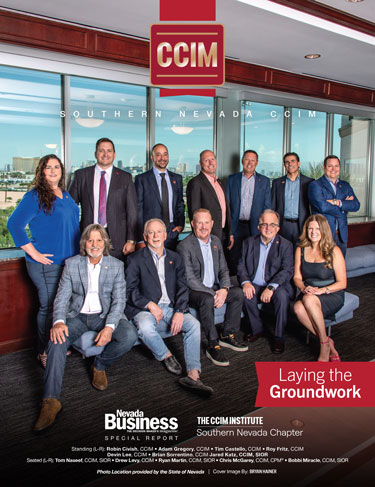
To receive Certified Commercial Investment Member (CCIM) designation is a sign of dedication to excellence and leadership in commercial real estate. This is especially true in Nevada, where CCIM chapters are flourishing.
Making History
Founded in the 1960s, the CCIM Institute offers education and analytical tools to its members across the country. The Institute has spent half a century skilling up communities to best respond to the ever-changing opportunities and challenges in the commercial real estate market.
The CCIM designation comes after an applicant successfully completes three parameters: coursework, a qualifying experience portfolio and a comprehensive exam. Once receiving the destination – and an enamel pin – doors open.
The southern Nevada chapter began in the late 1980s and continues to be led by top real estate professionals.
Jakke Farley, an experienced agent at Mountain West Commercial Real Estate and president-elect of the southern Nevada CCIM chapter, places a lot of trust in those with a CCIM designation.
“I view the CCIM designation as prestigious,” she said. “When I see that another agent involved in a transaction is also a CCIM, it immediately elevates the level of trust and professionalism in the deal. It signals a shared commitment to excellence, ethics and in-depth market knowledge.”
For Tim Castello, Castello Group and current president of the southern Nevada chapter, CCIM designees are often his go-to people.
“It’s easy to pick up the phone and reach out to other professionals in the business who are educated on what’s happening in the market,” he said. “It helps get deals done faster and smarter.”
Prioritizing What Matters Most
CCIM’s guiding light is educational opportunities. Along with the course requirements for designees, the organization provides continuing education on market trends and other timely issues.
“Unlike many other organizations with similar goals, education is the backbone of our organization, and it adds tremendous meaning to the other work we do,” Castello said. “We stay focused on our core values, which is first, education of membership.”
That’s what first attracted Jennifer Lehr, senior associate at Colliers and education director of the southern Nevada CCIM chapter, to the Institute.
“I spent the last 20 years of my career in commercial real estate, with a focus on retail investment sales and leasing as part of the Colliers team in Las Vegas,” Lehr said. “Early on, I recognized that continuing education and strong professional networks were key to success in our field.”
Lehr’s curiosity soon turned into membership, and now, leadership. For over a decade, her CCIM involvement has offered innumerable benefits.
“[I] quickly saw how the designation and the community elevated professional standards and fostered collaboration across the industry,” she said. “Over time, my involvement deepened — I’ve served on the programs committee, communications committee, and currently sit on the board of directors.”
In her role as the education director, she has been instrumental in delivering the high-quality learning programs members expect.
“I’ve worked to expand access to Southern Nevada CCIM (SNCCIM) courses, mentor newer members, and help coordinate local education events. We want to ensure that our community of real estate professionals remains highly skilled, informed, and engaged. Bringing top-tier CCIM education to Southern Nevada helps elevate the local industry as a whole.”
Still, while the prestige, network and education opportunities are valuable, Lehr said her long-term investment in CCIM is about community.
“I choose to stay involved because SNCCIM is about more than a designation,” she said. “It’s about fostering connections, advocating for our industry and providing opportunities for professionals at every stage of their careers to grow and contribute.”
Volunteerism and community are pillars of CCIM. “[I’ve had the opportunity] to not only grow professionally but also give back to the community—and we have a lot of fun doing it,” Farley said. “I’ve especially enjoyed volunteering with organizations like Three Square Food Bank and Project 150. Packing Thanksgiving boxes and helping provide meals to those in need is incredibly rewarding. It’s meaningful to be part of a group that values community engagement just as much as professional development.”
Chris Waldburger, an associate with ROI Commercial Real Estate and CCIM’s director of networking and social events, manages many of these opportunities.
“I work alongside my fellow committee members to plan and execute our chapter events,” he said. “These events are vital for building connections within the industry and beyond, enhancing professional relationships, and fostering collaboration within the local real estate community. Many of these events actually contribute to the community by supporting local organizations through charitable donations.”
Some of these charitable fund work supports the CCIM Scholarship Endowment Fund at UNLV, which helps students interested in real estate earn an education. Further partnerships with the university include hosting the International Council of Shopping Centers, as well as more direct mentorship programming.
The Personal and Professional Benefits of Membership
All CCIM’s values helped make Waldburger the professional he is today. “I got involved with our local CCIM chapter in 2020 as I was starting my career in commercial real estate,” he said.
Five of his coworkers were already CCIM designees who shared their experiences with the chapter. Their influence inspired Waldburger to start his application, and now, years later, he’s still seeing rewards.
“CCIM’s educational resources played a crucial role in deepening my understanding of the industry and complementing the hands-on experience I gained day-to-day,” he said. “I volunteered as a committee member throughout my education process, and after earning my designation in 2023, I realized the ongoing value of networking and the resources the organization offers.”
He’s relied on the same just-pick-up-the-phone network that Castello prides.
“Staying involved has allowed me to build valuable relationships with professionals adjacent to my work, including contractors, lawyers, title representatives, vendors, and other brokers, all of which have been instrumental in advancing my career.”
That commitment to continued, community success is one of the reasons Farley is active in the CCIM organization. “Being part of SNCCIM has provided invaluable opportunities to grow both personally and professionally,” she said. “I strongly believe in the values the chapter upholds—collaboration, integrity, and leadership—and I want to contribute to the continued success and development of our local commercial real estate community.”
The 2025 Legislative Session
Nevada’s 83rd Legislative Session adjourned in early June, and all these core values were on CCIM designees’ minds.
For Farley, there were two key issues on the docket that directly impact her sector: urban heat mitigation and federal land use for housing development.
She stood in support of Assembly Bill 96 which mandated both cities and counties with populations exceeding 100,000 (including Clark and Washoe counties) to integrate heat mitigation strategies into master planning.
“Heat mitigation” is a broad term, with the creation of public cooling spaces, access to clean drinking water, cool buildings, and increased shaded areas all considered measures in development planning.
“Given that Las Vegas and Reno are among the fastest-warming cities in the U.S., with temperature increases of 5.7 and 7.6 degrees, respectively, from 1970 to 2023, this bill is crucial for addressing the urban heat island effect and its impact on public health and infrastructure,” Farley said.
Land release, addressed in Assembly Joint Resolution 10 (AJR10), urged the federal government to allow specific lands to be used for housing developments in Nevada.
“This resolution is significant for CCIM members, as it could facilitate the development of affordable housing on federal lands, addressing the state’s housing shortage and potentially increasing opportunities for commercial real estate investment,” Farley said.
Castello also emphasized the importance of AJR10. “We’re very constrained in terms of our growth [in southern Nevada] with the limited amount of land we have to build on versus the land that the Bureau of Land Management owns here in the Las Vegas Valley,” he said.
It’s not just affordable housing that’s stunted by land accessibility, he said. “The amount of land we can use directly impacts recruiting for Fortune 500 companies, for development and building out the whole community,” he said. “It’s a huge issue.”
When it comes to commercial real estate, Lehr’s top priorities were similar.
“[In general], the real estate sector kept a close eye on bills impacting property taxation, affordable housing, landlord-tenant law, and commercial development,” she said.
In particular, Lehr watched bills like Assembly Bill 310 and Senate Bill 395, related to property tax abatements and commercial property disclosures, respectively.
“These types of bills can significantly influence how we structure deals, underwrite investments, and advise clients,” she said.
It’s when legislative items touch the day-to-day activities of members that Lehr said they feel most real.
“[This] legislative session underscored how important it is for us to educate our members on regulatory changes and to partner with other industry groups to advance shared priorities,” Lehr said.
Becoming Advocates
Traditionally, CCIM’s place has been education-based, especially in the legislative and political realms.
“CCIM’s role is to provide a forum where members can understand and discuss these changes, advocate when necessary, and adapt quickly to a shifting legal landscape,” Lehr said. “Staying engaged in the legislative process is critical for maintaining a healthy business environment in Nevada.”
However, Castello said his chapter is due for a change. “Historically, we have not done a lot of advocacy work for legislative affairs or otherwise,” Castello said. “For us, we’ve always had an informative role.”
Every year, there are issues that directly impact not only the industry at large, but also those with CCIM designations.
“We’re seeing an increase each legislative session of issues that matter to our members,” he said.
Castello said this year (and most years), water, land, zoning, and affordable housing legislation will directly impact CCIM’s sectors.
“I can only speak for myself when I say this, but I believe if you’re not informed or understand your stance on these issues, or if you’re not voting for the people who are supportive, that will have a huge impact on the real estate industry going forward,” he said.
Castello pointed to the growth of southern Nevada over the last few years, which added diversity in jobs, people, and politics.
“If you don’t have a voice [in government], you probably end up getting left behind,” he said.
In response, he’s “revving up” the engines on government affairs.
“My goal would be to see this CCIM chapter go from informative to outspoken. It’s important to inform our membership and make sure they have a good understanding of what the issues are. Then you have to take some kind of position in order for the needle to move on topics concerning the industry.”
This could come in a number of forms – from the formation of action committees to new leadership roles, or even potentially running candidates – though no formal or public plans have been laid.
“How this comes about we’ll have to discover as a membership, and as a board of directors, together,” he said. “But we’re excited for the future.”