Construction as an industry, including commercial real estate construction, is subject to safety rules and regulations from federal and state agencies. Federal requirements are implemented by the Nevada version of OSHA – the Occupational Safety and Health Administration, which operates under the U.S. Department of Labor. Nevada’s state-level OSHA is administered through the Nevada State Plan Office.
Nevada is considered stricter than many other states, with thorough jobsite safety rules and regulations of its own. The state requires supervisors, foremen and superintendents to take OSHA 30 training, and any employee on the site needs to have taken OSHA 10. The numbers refer to the hours the safety classes take to complete.
Nevada has stringent regulations covering the manufacturing of explosives and requires businesses to create and maintain a written workplace safety program. A company with 10 or more employees is required to have a written safety program in compliance with Nevada Revised Statues, and 25 or more employees means companies are required to have a safety committee which follows rules of operation.
“The state wants to make sure companies are playing by the rules to provide safe working environments for their employees,” said Abraham Camejo, CEO, certified safety and health official, Camejo Safety. Camejo Safety is a small, locally owned company that works with businesses of all sizes, in construction and in general industry. “Nevada is a very safe state, very strict, which is actually a good thing. I have workers who come here from all over the country to work on casinos and they say, ‘Whoa, so many certifications are required here.’ But the reason is, when we’re building good properties and good homes, we don’t want accidents on the jobsite,” he said.
“At the end of the day, what we’re trying to do is just have everybody go home safe,” Camejo added.
Who is Responsible?
Safety on the jobsite is everyone’s responsibility. But business owners are the ones held responsible for employee compliance with safety rules and for accidents on the job.
Being proactive is the best way for business owners to keep the jobsite running, whether that’s a commercial construction site, a housing development or a general industry business. When it comes to safety issues and needs, “You don’t know what you don’t know,” said Virginia Toalepai, president, World Wide Safety (WWS). The safety firm works with private companies to provide workplace training and audits of OSHA requirements and safety protocols. “A lot of companies think that safety is offering people PPE (personal protective equipment).”
But in order for employers to mitigate risk and stay proactive, every employee needs to go through safety orientation before ever setting foot on the jobsite. They also need to receive a copy of Nevada Employee & Employer Rights & Responsibilities from the Nevada Department of Business & Industry, detailing how to create a safe workplace.
In order for them to mitigate risk and make sure they stay proactive, businesses need to have their ducks in a row from the beginning. “They need to make sure, before any employees are out there and working, they’ve gone through safety orientation and that safety programs are readily available and up-to-date,” said Toalepai. “They need to make sure they continuously train employees, but most importantly, make sure they’re enforcing the rules. No safety program is worthwhile if it’s not enforced. That leaves businesses open to violations and citations from OSHA, and employees who don’t understand what’s in the program.
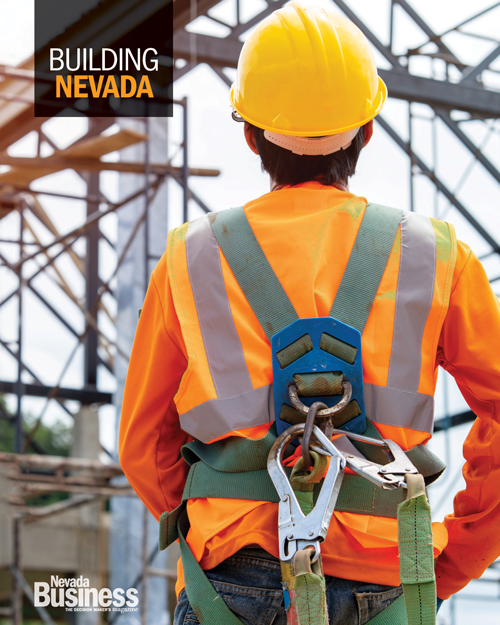
Workplace safety companies like Camejo and WWS help construction sites and business owners avoid penalties and fines from OSHA. They can perform walk through inspections to audit safety violations that would be flagged by OSHA, things like workers on roofs who are not tied off or using safety harnesses or lack of personal protective equipment such as hard hats and safety glasses.
Correcting violations can save owners money. In the last few years OSHA fines were raised. What was once $7,000 is now $14,000 and those that were at $70,000 doubled also, depending on the level of seriousness of citations, which take into account the level of violation, repeated and willful violations.
That’s per violation, said Camejo. “If you’re on the jobsite and you’re not wearing a hard hat or safety glasses or you’re on a roof and you’re not wearing fall protection like a harness, you’re looking at three or four violations right there.”
At which point the OSHA inspector can require manuals and training, and to know what the company is doing about safety training.
Companies have the opportunity to correct safety violations. Generally, they’re given three to four days to produce documentation showing changes are made. Usually if OSHA shows up on a site, Camejo said, it’s because someone has already made a complaint. “They’ve already got you,” he said. “They don’t just show up because they want to show up.”
Ongoing Training
Ongoing safety training is required. The documentation necessary to avoid fines for violations include sign-in sheets for tailgate safety meetings, evidence of employee retraining if required, and even then, OSHA can choose to waive the fine, or give a partial or full fine.
But OSHA can also help business owners be compliant with safety regulations. In addition to performing workplace inspections, the Safety Consultation and Training Section (SCATS) is the training and education side of Nevada OSHA.
“Businesses can reach out to us for help [in being in compliant], and it’s free of charge,” said Todd Schultz, chief administrative officer, SCATS. The sister agency to OSHA has very specific confidentiality rules. “So, if you’re working with the consultation side of OSHA, it’s not public information. The things we find, the things we identify, are confidential as long as the employer meets the requirements of working with us, which is to correct anything that’s considered a serious violation of the OSHA standard.” Serious means anything that could seriously injure or kill a worker. “The best way to mitigate violations is to be proactive,” Schultz added.
SCATS health professionals, certified industrial hygienists, can visit jobsites and walk through, perform safety audits and review written safety programs.
SCATS offers free programs for businesses. In the Voluntary Protection Program, management, labor and SCATS work together to prevent accidents and fatalities through hazard prevention, jobsite analysis, training, management commitment and worker involvement. Application and on-site evaluation are required.
The Safety and Health Practitioner Certificate Program recognizes participants who have attended at least 27 OSHA-standard based SCATS classes. The Safety and Health Achievement Recognition Program or SHARP acknowledges small businesses that used OSHA’s OnSite Consultation Program and operate safety/health programs.
OSHA compliance can enter a jobsite at any time. If the dollar amount of the job or the nature of the project isn’t what triggers the inspection, it could be a complaint from an employee or a third-party vendor.
“My recommendation would always be that it’s better for a contractor to understand what OSHA requires before they launch and complete an activity,” said Rod Savini, operations manager, Brycon Construction. “Because when you get into compliance, that can be spurred by a compliance inspection that OSHA would normally complete. They usually look at projects that are being completed and may look at a dollar value as a trigger point, or they may look at the type of work as a trigger point.”
One type of work that might draw scrutiny is asbestos removal or lead abatement, because those are highly controlled jobs that require employees to have special training and be certified to work in those environments. In that case, Savini said, OSHA compliance is essentially the police. “Consultation is the agency that helps you out initially,” said Savini. “If you have an activity you want to complete, or you’re a new contractor or new to the area, contact the SCATS side first and meet with them and understand what they offer. That helps you be aware of and comply with OSHA requirements before you ever have to deal with compliance.”
In a normal year, SCATS assists between 600 and 700 businesses with consultation visits and training. Between July 2020 and 2021, SCATS trained more than 4,800 employees. At the start of the pandemic, they fielded more than 1,000 calls a month. In 2020, they had more than 9,200 inquiries on COVID regulations.
Technology
Safety regulations change and evolve as industries change. Technology can make jobs safer, and regulations can enforce the technology. Communication technologies improved jobsite safety during the pandemic by replacing face-to-face meetings with video calls. However, smartphones can be a drawback when workers head to social media at inappropriate times, said Camejo.
Technology evolves to meet safety needs. For example, after OSHA changed regulations on safety measures for employees exposed to airborne carcinogens like silica, equipment manufacturers started changing design. Power saws are modified for wet cutting, which reduces silica dust and traps it in a slurry that can be vacuumed up without fear of it being inhaled, said Savini. Drills are manufactured with HEPA filtered vacuums to collect dust.
“Heavy equipment has improved with different sensors where it will alert you if you’re operating the equipment incorrectly, unlike older equipment that wouldn’t let you know until too late,” said Camejo. At the same time, he said, it’s possible to ignore the warnings the same as a driver can choose not to use a seatbelt. When it comes to an accident, no matter how safe the equipment, there’s usually operator error at the cause.
Technology helped keep various industries moving forward through COVID-19. Safety regulations evolved to include not only PPE but daily temperature checks of employees reporting to a job, COVID testing, and the ability to isolate workers who tested positive. Other regulations changed how employees operate in confined space and changed the amount of space workers are supposed to have.
“The capability of having everybody sign paperwork from their own individual phones is another big step [in pandemic safety],” said Toalepai. “Everything is now uploaded, technology-wise everything is digital.” The hands-off way of not sharing materials is a major step in keeping jobsites open during the pandemic.
The drawback, Toalepai said, is that the older generation of construction workers may not be as technologically savvy—or even interested. “Even if you give them a phone, forget it,” she said. And while the new generations automatically reach for their phones, they’re not automatically reaching for careers in construction.
Due Diligence
“Safety doesn’t make you money but it definitely does save money,” said Toalepai. “Safety takes time.”
“Safety is costly, and very costly when people get hurt,” said Savini. It’s costly in terms of the employer’s reputation. And it’s costly in terms of workers who get hurt. “It affects their family, it affects their earning potential, it affects a lot of things, so the impetus of that, we’ve seen construction change over the last several decades. The impetus is on people going to work with 10 fingers and 10 toes and going home the same.”
Camejo suggests business owners review company safety manuals and policies, and update everything on a regular basis. Because if a company doesn’t have an updated manual when OSHA comes to call, they can have a problem for not updating their own policies.
It can be hard to implement safety procedures. One of the issues facing the construction industry in 2021 is the lack of workers. With Nevada construction booming statewide, the need for workers is incredibly high, especially with the younger generations not coming in to take jobs.
That means it’s a worker’s market. “A lot of these guys don’t really care if they get fired from the next framing company or the next job, because they can just go down the street and someone else will pick them up,” said Toalepai.
The problem with that is there’s protocol set in place to track workers. Business owners are tracked for violations and fines, but workers can quit and get picked up by the next company without anyone following up on references or learning the employee was fired for safety violations.
“So, the person that got fired from one company because of their safety records or not following safety protocol, now has another chance to work unsafe somewhere else. They could kill the next person over with another company that doesn’t prioritize safety,” said Toalepai. It’s especially true with companies that don’t prioritize safety from top to bottom, meaning starting with management and making sure everyone in the company follows safety regulations.
“We’re failing to control employees who go from one company to the next because nobody is really following up on their references, why they got fired, [the employers just] want the manpower,” said Toalepai. “That’s the biggest struggle right now in construction.”
“The point of all the programs is to go home,” said Camejo. “To go home to your families. It’s not to make more rules. It’s like COVID. Everybody hated COVID rules but it’s safety. It’s to go home and to be safe. Nobody leaves their home to get hurt. They go to work to provide for their family, and everybody has the right to a safe working environment.”